
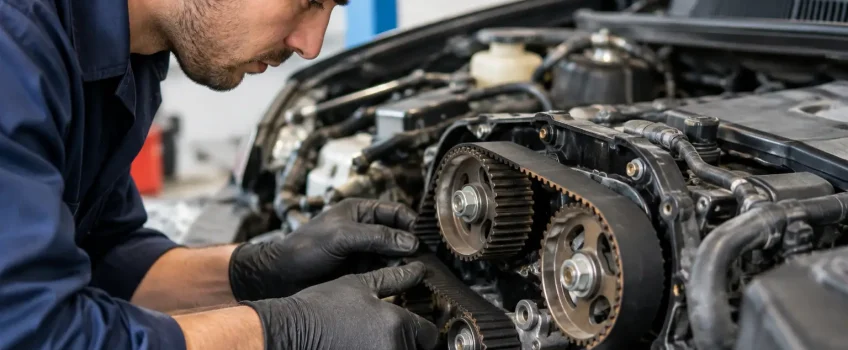
Timing Belt Replacement in Epping NSW Explained
A timing belt can look perfectly fine from the outside right up until it fails. That is what makes timing belt replacement Epping NSW drivers need to plan for, rather than put off until there is a noise or warning light. For many vehicles, a broken timing belt can stop the engine instantly and may lead to major internal engine damage.
For commuters, families and business owners who depend on their vehicle every day, replacing the belt at the correct interval is one of the clearest ways to avoid an expensive and inconvenient breakdown. It is routine maintenance with a serious job: protecting the engine that gets you to work, school drop-off, appointments and weekends away.
What a timing belt does
Your engine relies on precise timing. The timing belt connects the crankshaft and camshaft, keeping the pistons and valves moving in the correct sequence. When everything is working as it should, the engine starts easily, runs efficiently and delivers the performance you expect.
If the belt becomes worn, contaminated or damaged, that timing can be affected. If it breaks, the engine stops turning correctly. In many modern engines, the pistons and valves can collide when the belt fails. This is known as interference engine damage, and repairs can be far more costly than replacing the belt as scheduled.
Not every vehicle uses a timing belt. Some have a timing chain, while others use different engine designs. The best way to know what your vehicle needs is to check the manufacturer’s service schedule and have a qualified mechanic confirm the correct requirements for your make, model and engine.
When is timing belt replacement due?
There is no single kilometre figure that applies to every car. Depending on the manufacturer, timing belt replacement may be recommended anywhere from around 60,000 to 150,000 kilometres, or after a set number of years. Age matters as much as distance travelled because rubber deteriorates over time, even in a car that does not do many kilometres.
Your log book is the starting point. It sets out the service interval specified for your particular vehicle and is especially useful for new-car owners wanting to maintain their manufacturer warranty. If you have bought a used vehicle and cannot confirm that the timing belt has been changed, it is wise not to assume it has been done. Service records, receipts and a clear sticker under the bonnet can help, but a workshop can also assess what information is available and advise on the sensible next step.
Short trips, stop-start Sydney traffic, high temperatures, oil leaks and long periods off the road can all affect belt condition. A vehicle that has only travelled a modest distance may still be due based on age.
Signs that should not be ignored
A timing belt often gives little or no warning before failure, which is why following the scheduled interval is so important. Still, certain symptoms can point to a problem that needs prompt inspection.
Difficulty starting, rough running, misfiring, a ticking sound from the engine area or a loss of power should be checked. An oil leak around the front of the engine also deserves attention, as oil can damage the belt material. If the engine has stopped suddenly while driving, do not keep trying to restart it. Arrange for the vehicle to be assessed first, as repeated cranking can make damage worse in some circumstances.
These signs do not automatically mean the timing belt is at fault. Similar issues can be caused by ignition, fuel, battery, sensor or other engine problems. Proper diagnosis matters because replacing parts based on a guess is rarely the most cost-effective answer.
Timing belt replacement in Epping NSW: what is included?
Timing belt replacement is more involved than fitting one new belt. Access can require removing covers, pulleys, engine mounts and other components, depending on the vehicle. The mechanic must then align the engine accurately, replace the required parts and reassemble everything to the manufacturer’s specifications.
It is common to replace associated components at the same time, particularly the tensioner and idler pulleys. These parts guide and maintain the correct belt tension. Reusing a worn tensioner or pulley with a new belt can create a weak point in the system, so a complete timing belt kit is often the more sensible option.
On many vehicles, the water pump is driven by the timing belt or sits behind the same covers. Replacing it during the timing belt job can save labour compared with returning later to access the same area again. It is not always necessary, but it is worth discussing with your mechanic based on the water pump’s condition, age and the manufacturer’s recommendations.
A professional service should also include checks for coolant or oil leaks, correct tension and alignment, and a road test where appropriate. The aim is not simply to fit parts, but to return the engine to reliable operation.
Why delaying the job can cost more
It is understandable to weigh up a timing belt replacement against other household or business expenses. The difficulty is that timing belts do not gradually become less useful in a way that is easy to manage. They can fail without much notice.
Replacing a belt before its due date is usually unnecessary, unless there is a condition issue or the vehicle history is unknown. Waiting well beyond the recommended interval, however, is a gamble with an essential engine component. If the belt fails in an interference engine, repairs may involve valves, cylinder head work or even an engine replacement.
There is also the practical cost of being stranded. A breakdown on the way to work, during school pick-up or while managing a fleet schedule creates disruption that is difficult to price. Planned maintenance lets you choose a convenient booking time instead of dealing with an urgent tow and unexpected repair decision.
Choosing a workshop for the job
A timing belt replacement requires accurate information, the correct parts and careful workmanship. When booking, provide your registration, vehicle make, model, year and engine details if you have them. This helps the workshop identify the correct service interval and parts required before work begins.
It is also reasonable to ask what the quoted work includes. A clear explanation should cover whether the timing belt kit includes tensioners and pulleys, whether the water pump is recommended, and whether coolant or other fluids may be required. The cheapest quote is not always the best value if essential related components are left out.
At Epping Auto Service, licensed mechanics can assess your vehicle’s timing belt requirements, explain the recommended work in plain English and carry out the repair with care. Whether you are keeping up with a log book schedule or sorting out an uncertain service history, the focus is on practical advice and reliable workmanship.
Keep the next service date easy to find
Once the timing belt has been replaced, keep the invoice with your service records and note the next recommended kilometre and date interval. This makes future servicing simpler and provides useful information if you sell the vehicle.
If you are unsure whether your timing belt is due, a quick conversation with a local workshop can give you clarity before a small maintenance decision becomes a much larger repair.