
Why Car Battery Drains and What to Do Next
A car that cranks slowly in the driveway before work, then will not start after the school run, is more than an inconvenience. When car battery drains become a repeated problem, the battery may not be the only part at fault. The charging system, electrical accessories, driving habits and even a loose connection can all play a part.
A flat battery is one of the most common reasons for a breakdown, but it is also one of the most misunderstood. Replacing the battery may solve the issue, or it may simply hide a fault that will flatten the new one as well. A proper inspection helps identify why the battery lost its charge and what needs attention to keep your vehicle dependable.
The most common reasons car battery drains
An ageing or weak battery
Car batteries do not last forever. In Sydney conditions, many batteries last around three to five years, although heat, short trips and heavy electrical use can shorten that lifespan. As a battery ages, it holds less charge and can struggle to supply the high current needed to start the engine.
A weak battery may still start the car after a long drive, then fail after sitting overnight. You might notice slower cranking, dimming headlights, warning lights on the dash or electrical features that act inconsistently. These are useful early signs to have the battery tested before you are stranded.
Lights or accessories left on
An interior light, boot light, glovebox light, headlights or an accessory left plugged in can drain a battery while the vehicle is parked. Modern cars also have many systems that stay on briefly after the ignition is switched off, so it is not always obvious what is using power.
One accidental flat battery does not necessarily mean there is a fault. After the battery has been fully recharged and tested, the vehicle may be fine. However, if it goes flat again without anything being left on, further diagnosis is worthwhile.
Short trips that do not recharge the battery
Starting an engine uses a substantial amount of battery power. The alternator replaces that power while you drive, but very short or infrequent trips may not give it enough time to do its job. This is common for cars used mainly for quick local errands, school drop-offs or occasional weekend driving.
The issue can be worse in winter, when cold starts require more power, or when the air conditioning, headlights, demister and infotainment system are all in use. A longer drive can help recharge a healthy battery, but it will not repair a worn-out battery or a charging-system fault.
Alternator or charging-system problems
The alternator supplies electricity when the engine is running and recharges the battery. If it is not charging correctly, the battery gradually runs down even though the vehicle may seem normal at first.
Possible signs include a battery warning light, headlights that brighten or dim with engine speed, a burning smell from a slipping belt, or a vehicle that stalls once the battery charge is depleted. Do not assume that a battery warning light means the battery itself needs replacing. It often points to an alternator, belt or wiring issue that needs professional testing.
A parasitic electrical drain
A parasitic drain is an electrical draw that continues after the car has been switched off and should be asleep. Some small draw is normal because the clock, alarm, central locking and vehicle memory need power. The problem starts when a module, relay, aftermarket accessory or wiring fault keeps using more power than it should.
This type of fault can be frustrating because the car may start normally after a charge, then be flat again after sitting for a day or two. Dash cameras, mobile chargers, sound systems and tracking equipment can sometimes be involved, but a fault can also occur in factory-fitted components. Finding the cause requires measured testing rather than guesswork.
Corroded or loose battery connections
Battery terminals need a clean, secure connection. Corrosion around the terminals, loose clamps or damaged cables can interrupt the flow of power and create symptoms similar to a failing battery. In some cases, the battery has sufficient charge but cannot deliver it properly to the starter motor.
If you see white, blue or greenish build-up around the terminals, or the clamps can move by hand, arrange an inspection. Avoid using improvised tools around the battery terminals, as a short circuit can cause damage or injury.
What to do when your car will not start
First, switch off lights, air conditioning and accessories. Check whether the dash lights come on and listen carefully when you turn the key or press the start button. A rapid clicking sound or very slow crank often suggests low battery power, while no response at all can point to a connection, starter or electrical issue.
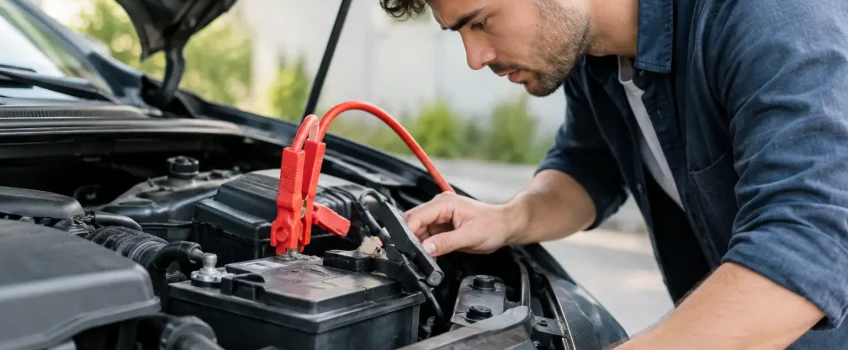
If you need a jump-start, follow the vehicle manufacturer’s instructions and use suitable jumper leads or a jump pack. Never connect leads if the battery case is cracked, leaking, swollen or damaged. Keep sparks, cigarettes and flames away from the battery, and make sure the vehicles are not touching.
After a successful jump-start, do not treat the problem as solved. Drive directly to a safe location or book a battery and charging-system check. Turning the engine off soon afterwards may leave you unable to restart, particularly if the battery is old or the alternator is not charging.
Why a battery test is better than replacing parts blindly
A workshop battery test checks more than voltage. Voltage can appear acceptable when a battery is resting, yet the battery may fail under the load of starting the engine. A proper assessment can check battery condition, cranking performance, terminal connections and alternator output.
This matters because the right repair depends on the result. If the battery is simply at the end of its life, fitting a correctly sized replacement is usually straightforward. If the alternator is weak, replacing only the battery will not prevent another flat start. If there is a parasitic drain, the vehicle needs electrical diagnosis to identify which circuit or component is responsible.
At Epping Auto Service, our technicians can test the battery and charging system, inspect related wiring and fit an appropriate in-stock replacement battery when needed. Clear diagnosis helps avoid spending money on parts that are not actually causing the problem.
Can you prevent a flat battery?
Regular servicing gives your mechanic the chance to check the battery condition and connections before a failure becomes urgent. It is especially sensible to request a battery test before a road trip, after the battery has gone flat, or if your car is more than a few years old and still has its original battery.
For cars that sit unused for extended periods, a battery maintainer may be suitable, provided it is used according to the manufacturer’s instructions. Starting the vehicle and idling it in the driveway is not always enough to recharge the battery. If practical, a proper drive is more useful, although a weak battery should still be tested.
Be thoughtful with accessories as well. Unplug chargers when they are not needed, check that doors and the boot are fully closed, and have aftermarket electrical equipment installed and checked by qualified technicians. These simple habits reduce the chance of an unexpected drain.
When to book your vehicle in
Book an inspection promptly if your battery has gone flat more than once, the battery warning light appears, the engine cranks slowly, or you have needed a jump-start. It is also wise to act if the battery is swollen, leaking or has a strong sulphur-like smell. Those signs can indicate a damaged battery that should not be ignored.
For families, commuters and fleet drivers, reliability is part of road safety. A quick check now can prevent the stress of being stuck in a car park, outside home or on the way to an important appointment. If your vehicle is giving you early warning signs, arranging a professional battery and electrical check is the practical next step.